

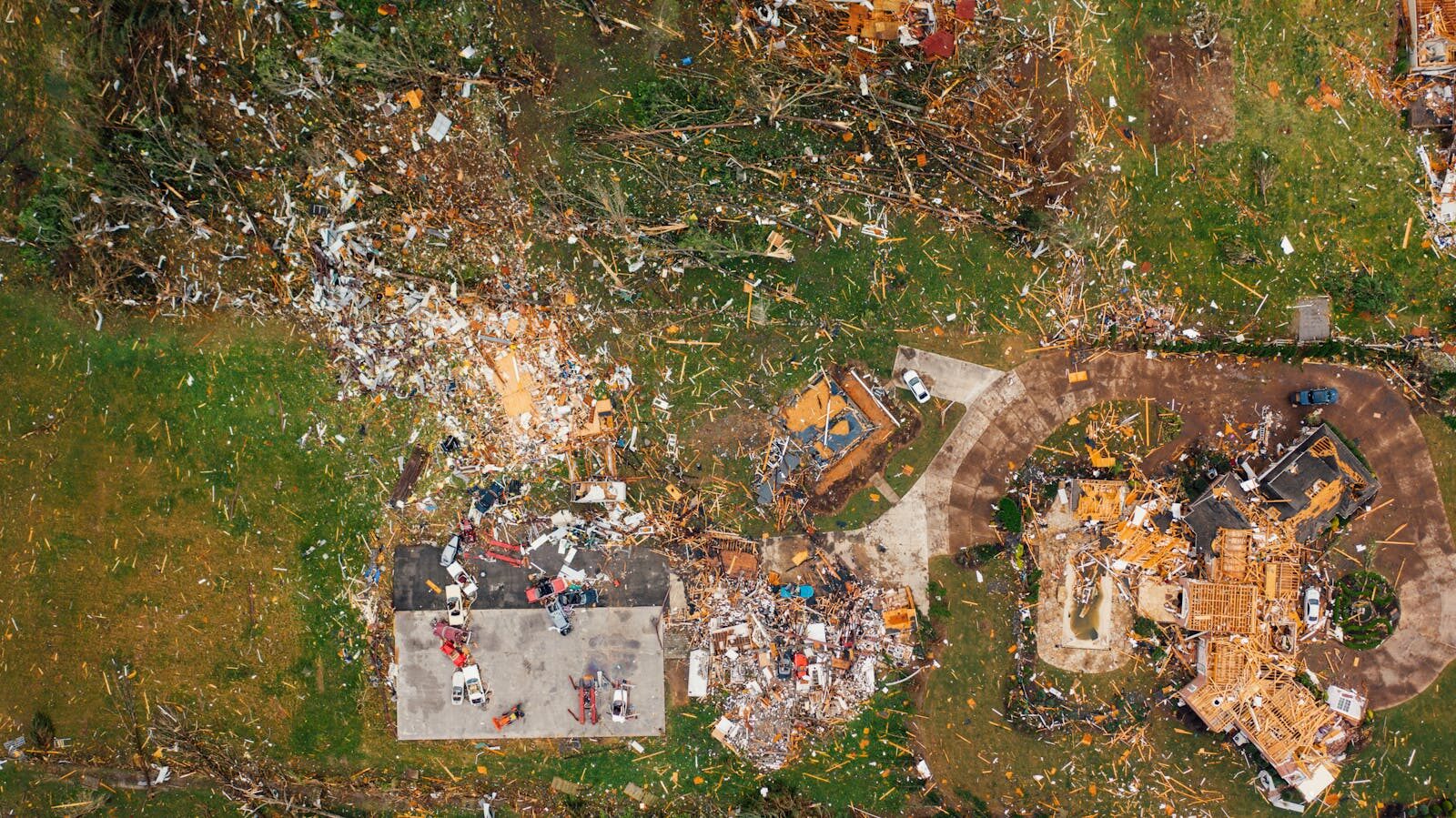
Table of Contents:Storm-Damaged Property in NC & SC: Repair or Demolish?
Storm-Damaged Commercial and Residential Property in the Carolinas: When Demolition Is the Right Call
Every June 1, the Atlantic hurricane season officially opens, and every property owner in the Carolinas runs the same quiet calculation: what happens if the next storm hits my building. For 2026, the forecast offers some breathing room. NOAA’s seasonal outlook, released May 21, predicts a below-normal Atlantic season, with roughly 8 to 14 named storms expected and an emerging El Niño working to suppress development.
A quieter forecast is not the same as a quiet season. As NOAA’s National Weather Service director put it when the outlook dropped, it only takes one storm to make a bad year — and the Carolinas know that better than most. Hurricane Helene’s catastrophic flooding across western North Carolina in late 2024 is still being cleared, and the Piedmont absorbs tornadoes, straight-line wind events, and tropical remnants every year regardless of the basin-wide numbers. A single supercell can total a strip center in twenty minutes.
When a storm does serious damage, the hardest decision is rarely emotional — it’s structural and financial: do you attempt a costly restoration, or is the building beyond saving? Property owners often default to repair out of habit, sinking large sums into structures that are fundamentally unsafe or financially non-viable. At Atlas Demolition, we look at storm damage through the objective lens of structural reality, regulatory compliance, and long-term asset protection. We work with residential and commercial property owners across the Carolinas — from Charlotte and Rock Hill out to Fort Mill, Clover, and the surrounding counties — and because storm recovery often takes more than one service, our work spans selective demolition, total teardown and haul-off, asbestos abatement, concrete removal, and debris cleanup. This guide lays out how the repair-versus-demolish decision actually gets made, who has a say in it, and what to do — and avoid doing — in the days after a storm.
Storm Damage Is Not Always Surface Damage
After a major storm, the visible damage gets attention first: missing roof sections, torn siding, a tree resting on the structure, standing water inside. On commercial sites, add damaged storefronts, parapets, canopies, signage, and loading docks. But the larger concern is what cannot be seen right away.
A storm can compromise roof trusses, framing, floor systems, masonry walls, foundations, crawl spaces, electrical systems, gas lines, and fire-suppression equipment without leaving an obvious exterior sign. OSHA’s guidance on structural collapse warns that damaged structures can involve unstable framing, energized wiring, gas leaks, contaminated water, hazardous materials, airborne dust, asbestos, silica, and confined-space risks — a list of hazards a property owner standing in the wreckage cannot reliably assess alone.
That is why a storm-damaged building should be evaluated before anyone begins cleanup, gutting, or demolition. Depending on the property, the right reviewers may include a licensed contractor, a structural engineer, your insurance adjuster, the local building official, a utility provider, and a demolition contractor. The goal of that early assessment is to answer one question honestly: are the building’s primary load paths intact, or has the skeleton been compromised?
Repair or Demolish? The Decision Is Not Entirely Yours
Most owners assume the choice is theirs alone, or a matter to settle with their insurer. In reality, several parties can independently push a damaged structure toward demolition, and understanding who they are prevents costly surprises:
- Your insurance carrier decides whether the building is a “total loss” for claim purposes.
- The local building official decides whether the structure is safe to occupy or must be condemned.
- The floodplain administrator decides, for properties in flood zones, whether federal rules require the building be brought to current code — a determination that often makes repair impractical.
- You, weighing the economics of repair against rebuilding once the above are known.
Any one of these can be the deciding factor. A building your contractor calls “repairable” may still have to come down because it sits in a flood zone and the repair math triggers a federal compliance rule. Knowing the framework before you’re standing in the wreckage is what keeps the recovery moving.
Who Calls a Building a “Total Loss”?
The phrase gets used loosely, but it has distinct meanings depending on who’s saying it. Your insurance carrier declares a total loss when repair cost meets or exceeds the building’s insured value, or when a “constructive total loss” applies — the structure is technically repairable, but doing so makes no economic sense. That determination drives your payout, but it does not, by itself, give anyone the legal authority to demolish. City and county building officials in both Carolinas have that authority: when a building is structurally compromised, they can issue an unsafe-building notice or a demolition order, which is a legal directive (and, as we’ll see, unlocks a faster regulatory path). And the federal floodplain rule can force the issue regardless of what you or your insurer prefer.
Structural Red Lines: Signs a Building May Be Beyond Repair
Look past cosmetic destruction. The conditions below are the ones that most often lead to a teardown recommendation on engineering grounds. None replaces a professional structural assessment, but each is a serious warning sign.
Foundation shift and soil washout. The red clay soil across the Charlotte region and upstate South Carolina behaves like a sponge. In historic rain events it saturates and expands, putting immense hydrostatic pressure on basement and crawlspace walls; flash flooding can wash the structural fill out from beneath concrete footings entirely. Horizontal cracking in block walls, bowing foundation walls, or a visible tilt in the framing all point to foundation failure — and underpinning a ruined foundation can easily cost more than a full teardown and a new, code-compliant slab.
Broken load-bearing framing. High winds and falling timber load roofs and walls in ways they were never engineered for. When a mature Piedmont oak comes down on a building, it doesn’t just damage shingles — it transfers tons of kinetic energy through the exterior walls and into the floor system. Multiple buckled load-bearing studs, or shattered ridge beams and rafter ties, mean the integrity of the whole envelope is in question.
Water saturation and contamination. Storm flooding is rarely clean. Floodwater is frequently contaminated with sewage, fuel, agricultural runoff, and other hazards — what the restoration industry classifies as “black water.” When water sits inside a structure for more than 24 to 72 hours, porous materials (drywall, insulation, subfloor, framing) absorb it completely. Wood framing warps and loses load-bearing capacity, and in the humid Carolina climate, mold colonization begins fast — turning a structure that “looks fine” into a respiratory hazard that is expensive and slow to remediate safely.
Safety warning: Never enter a storm-damaged building that has been red-tagged by inspectors or shows signs of structural sagging. Energized wiring, gas leaks, and delayed structural collapse pose an immediate threat to life. If a building official has condemned the structure, stay out and call professionals.
When Repair Still Makes Sense
Demolition is not always the answer, and a contractor worth trusting will tell you when it isn’t. If the damage is limited, the structure is stable, utilities are safe, and affected materials can be removed and replaced without creating larger safety problems, repair is the better path. That’s often the case when roof damage is localized, water intrusion was caught quickly, framing remains sound, and hazardous-material concerns are limited.
For many of these properties, selective demolition is enough. Damaged drywall, flooring, insulation, ceilings, and non-load-bearing walls can be removed so a restoration team can rebuild correctly — without taking down the entire structure. For commercial buildings, this can preserve useful portions of the property while preparing the damaged areas for repair or tenant improvements. Atlas handles this through interior and exterior demolition, which is purpose-built for removing storm-damaged materials without a full teardown.
The Restoration vs. Demolition Decision Matrix
When a building checks multiple boxes in the demolition column, attempting a restoration is rarely viable. This is the framework we walk owners, asset managers, and adjusters through:
| Evaluation factor | Repair / Restoration | Complete Demolition |
|---|---|---|
| Structural integrity | Viable if framing is sound and the foundation is stable | Indicated when load-bearing members buckle or footings are undermined |
| Water & environmental risk | Manageable if caught early; needs drying and possible remediation | Clears lingering mold, contamination, and hazardous-material risk with the site |
| Cost vs. value | Repair can quietly exceed the building’s value once hidden damage surfaces | Predictable cost and a clean, code-compliant rebuild |
| Code & floodplain compliance | May force a grandfathered building up to current code, or trigger the FEMA 50% rule | Replacement is built to current code from the ground up |
| Timeline | Months, with extended drying and structural-repair phases | Often one to two weeks once permits and notifications clear |
The FEMA 50% Rule: The Trigger Most Owners Don’t See Coming
If your property sits in a FEMA-designated Special Flood Hazard Area — the 1-percent-annual-chance floodplain — a federal rule under the National Flood Insurance Program can override the simple repair-versus-replace math.
Under FEMA’s “substantial damage” standard, a structure in the floodplain is considered substantially damaged when the total cost to repair it reaches 50 percent or more of its market value before the disaster — regardless of what caused the damage. Once a building crosses that threshold, the local community (whether that’s Mecklenburg County code enforcement, York County, or another jurisdiction) cannot simply issue a standard repair permit. The entire structure must be brought into compliance with current floodplain regulations, which can mean elevating it above the base flood elevation, rebuilding with flood-resistant materials, adding proper flood venting — or full demolition and reconstruction.
A few details matter for owners trying to plan:
- The 50 percent figure is a federal floor, not a ceiling. A Carolina community can adopt a stricter local threshold, such as 30 or 40 percent, so the trigger may be lower than you expect.
- The calculation is based on repair cost, not your insurance payout. Officials use the cost to fully restore the building to its pre-damage condition at typical market rates. A low bid or your own labor doesn’t change the math.
- Upgrades don’t count toward the threshold — only the cost to return the building to what it was.
- The local floodplain administrator makes the determination and issues a substantial damage determination letter, which you’ll also need to access certain insurance benefits.
For an older, ground-level building, the cost of elevating a waterlogged structure often makes restoration a financial impossibility, and a clean teardown plus a modern, compliant rebuild is the more practical path. There’s also a piece of good news buried in the NFIP rules: standard flood policies include Increased Cost of Compliance (ICC) coverage, which can provide up to $30,000 toward bringing a substantially damaged building into compliance — and that money can be applied to demolition, elevation, relocation, or floodproofing. If your building is in a flood zone and receives a substantial damage determination, ask your adjuster about ICC coverage before anything comes down.
What to Do Before Anything Comes Down
This is the single most important piece of practical advice in this guide, and the step owners most often rush past in the urgency after a storm.
Before any demolition — emergency or planned — document the damage thoroughly. Photograph and video every elevation of the building, every room, and every instance of structural, water, and contents damage. Keep any records of the building’s pre-storm condition. Do not dispose of damaged materials or begin clearing until your insurance adjuster has either inspected the property or explicitly released you to proceed.
The reason is simple: once a building is demolished, the evidence of what it was and how badly it was damaged is gone. An adjuster cannot fairly value a claim on a structure that no longer exists, and an owner who demolishes prematurely can find a payout reduced or disputed. The only exception is a genuine safety emergency where a building official has ordered immediate demolition — and even then, photograph everything you safely can first. A reputable demolition contractor will not pressure you to start before your documentation and insurance steps are in order. If one does, treat it as a warning sign.
Emergency Demolition vs. Planned Demolition — and the Asbestos Rule That Bends
Storm demolitions split into two paths that run on very different timelines.
Planned demolition follows the standard sequence: structural assessment, asbestos survey, the 10-working-day federal asbestos notification, utility disconnects, permitting, abatement if needed, then the teardown. This is the path for buildings that are damaged but not in immediate danger of collapse, and it follows the same regulated process we detail in our guide to commercial demolition regulations in the Carolinas.
Emergency demolition is different — but narrower than most people assume. Federal asbestos rules under the EPA’s NESHAP standard include a specific provision for structures being demolished under a government order because they are structurally unsound and in danger of imminent collapse. In that situation, the normal 10-working-day asbestos notification compresses dramatically: written notice must be filed as early as possible before work begins, but no later than the following working day.
Three things about this provision are routinely misunderstood, and getting them wrong creates serious liability:
- An owner cannot self-declare an emergency. The relaxed timeline applies only when a state or local government agency — typically a building official — has issued an order declaring the structure unsound and in imminent danger. A copy of that order has to accompany the notification. Your own urgency, your insurer’s, or your contractor’s does not qualify.
- The asbestos itself does not get a pass. Even under an emergency order, the portion of the structure containing regulated asbestos material must be adequately wetted during the wrecking operation to control fiber release, and the other emergency-procedure requirements still apply. The rule compresses the paperwork timeline; it does not eliminate the hazard controls.
- Small homes are generally outside NESHAP entirely. The federal asbestos demolition rule applies to commercial, industrial, and institutional buildings, and to residential structures with more than four dwelling units. A single-family home or small duplex is typically exempt from NESHAP notification — though state asbestos rules, worker-safety requirements, and disposal regulations can still apply, and a survey is still prudent before disturbing older materials.
The takeaway: true emergency demolition exists and moves fast, but it runs on a building official’s order, not an owner’s say-so. A contractor who claims they can skip the asbestos process because “it’s a storm emergency” — without an actual demolition order in hand — is exposing you to federal Clean Air Act liability.
The Disaster Demolition Process, Step by Step
Demolishing a storm-compromised structure demands more planning than a standard controlled teardown, because the building is inherently unstable. Our crews operate with that in mind:
- Step 1 — Emergency stabilization. Before heavy equipment arrives, structural specialists inspect the site. Where needed, we deploy temporary shoring or stabilizers so the building does not shift or collapse unexpectedly while the work zone is set up.
- Step 2 — Emergency utility disconnection. Storms frequently leave live electrical lines tangled in debris or fracture gas mains. We coordinate on an accelerated timeline with the relevant providers — Duke Energy, York Electric Cooperative, Piedmont Natural Gas, and the local water and communications utilities — to sever connections at the source before demolition begins.
- Step 3 — Permitting (including the emergency path where it applies). After a declared disaster or severe storm event, jurisdictions sometimes open expedited permitting channels, and a building official’s demolition order can trigger the compressed asbestos-notification timeline described above. We manage the municipal filings and notifications so the project isn’t held up unnecessarily.
- Step 4 — Controlled dismantling. Equipment operators use excavators with hydraulic grapples and processors rather than wrecking balls, which create unpredictable impacts. The structure is taken down in a controlled sequence, pulling material inward onto the building’s footprint to protect adjacent structures.
- Step 5 — Foundation and footing removal. Once framing is cleared, hydraulic breakers remove waterlogged slabs, footings, and crawlspace walls so no underground obstructions remain to interfere with rebuilding.
Environmental Hazards a Storm Unleashes
Severe weather doesn’t just break a building — it tears open hazards hidden inside the walls. For older Carolina properties, structural damage routinely exposes regulated materials that demand careful handling.
Asbestos. Asbestos was an industry standard for decades, built into pipe insulation, roofing felts, floor tile, and ceiling textures. When wind or falling trees crush these materials, fibers become friable — crumbling into microscopic dust that’s easily inhaled. EPA guidance on disaster debris and damaged buildings warns that cleanup and demolition can involve asbestos concerns, and both states enforce strict rules. North Carolina’s Health Hazards Control Unit directs owners and contractors to inspect, obtain permits when required, notify the agency, and safely remove asbestos-containing materials before demolition or renovation — and NC notification is generally required 10 working days in advance even when no asbestos is found (subject to the emergency provision above). South Carolina’s SCDES imposes the same 10-working-day advance notification for regulated facilities, even when an inspector finds no asbestos present. You cannot simply scoop storm debris into a roll-off dumpster if it may contain asbestos; a qualified inspector has to assess the site first.
Lead paint. Buildings constructed before 1978 very likely contain lead-based paint. When a storm shears away siding or breaches a wall, lead-painted surfaces are pulverized into contaminated dust and chips that settle into the surrounding soil. Proper demolition uses dust-suppression — water fogging and wetting — to keep lead and other contaminants from migrating off-site onto neighboring properties.
Atlas handles the asbestos side through testing by a certified third-party inspector, then asbestos abatement and removal once results are confirmed — which matters enormously after a storm, when the temptation to “just clear it” is strongest and the consequences of disturbing these materials are most severe.
Storm Debris Is Still Regulated Debris
A common assumption after a major storm is that disaster conditions suspend the normal rules for handling demolition debris. They don’t. Asbestos-containing material still has to be handled by qualified workers and disposed of at approved landfills with manifests retained. Lead-painted debris, fluorescent lamps, mercury-containing devices, and other regulated wastes keep their own handling requirements. And the construction-and-demolition waste from a teardown still has to go to permitted facilities, with the disposal records that lenders, insurers, and municipalities expect during rebuilding.
There’s also a logistical reality after a regional storm: local landfills implement intake caps and standard roll-off dumpsters become hard to source as demand surges. Atlas maintains its own fleet of dump trucks and hauling equipment, which keeps storm projects moving independently of third-party dumpster shortages. We also sort materials on-site — clean concrete and masonry separated for crushing into aggregate base, and structural steel, iron, and copper routed to scrap recyclers. That source-separation reduces landfill volume and tipping fees while supporting the waste-diversion goals both Carolinas increasingly favor, and it’s part of our concrete and debris removal service.
Commercial Storm Damage: Time Is the Hidden Cost
For commercial owners, the storm-demolition calculus carries a variable residential owners face less acutely: every week the building sits unusable costs money in lost rent, idle operations, lease obligations, and stalled redevelopment. A damaged warehouse, retail center, office, restaurant, or industrial facility that can’t be reoccupied is a financial drain regardless of how the insurance claim resolves — and a partially collapsed roof or unstable exterior wall creates immediate liability toward tenants, employees, customers, and neighboring properties.
That pressure makes it tempting to rush, and rushing into demolition before documentation, insurance, and (in flood zones) the substantial damage determination are squared away is how owners create bigger problems. The better approach is to move deliberately but quickly: get the structural assessment and adjuster inspection done in parallel, confirm the regulatory path, line up utility disconnects, and engage a contractor who can execute the teardown and haul-off on a commercial timeline once the green light comes. Atlas handles full commercial demolition and total teardown and haul-off across the Carolinas, including the regulatory coordination that keeps a project from stalling.
Residential Storm Damage: A Simpler Path, With Real Exceptions
Homeowners often feel pressure to start clearing immediately, especially with water entering the home or debris scattered across the property. Some cleanup is genuinely urgent — but structural demolition shouldn’t be rushed without a plan. A home may need demolition when a tree has crushed a major portion of the structure, the roof or walls have shifted, the foundation has failed, flood damage is severe, or the building is simply unsafe to occupy.
Two exceptions catch homeowners off guard. First, the FEMA 50% rule applies to homes too — if your house is in a flood zone and the repair cost crosses the substantial-damage threshold, you face the same compliance requirements as any other structure, and possibly demolition with elevated reconstruction. Second, older homes can still harbor asbestos and lead, particularly in flooring, siding, pipe insulation, and pre-1980s materials, and disturbing them during a teardown carries real hazards even when federal notification isn’t legally required. Atlas provides residential demolition throughout the Charlotte and Rock Hill region, including storm-damaged homes, and can advise whether testing and abatement are warranted for your specific property.
What Storm Demolition Costs — and What Drives the Number
Transparency on cost matters for insurance claims and budgeting, but storm demolition varies too widely for a single figure. The budget is dictated by the building’s structural condition, the presence of hazardous materials, the amount of foundation and concrete work, and how safely heavy equipment can access the site.
As a rough, illustrative guide for the Charlotte and Rock Hill area — not a quote — a single-story home with moderate storm or tree damage often falls somewhere in the low-to-mid five figures for a complete teardown and site clearing, while large multi-story homes and commercial structures with serious structural compromise can run substantially higher, driven by safety shoring, extensive foundation extraction, and hazardous-waste disposal. Every project carries distinct structural and environmental variables, so the only accurate number is one based on an actual site assessment. We’re glad to provide a free, detailed estimate you can submit to your insurance adjuster.
Why DIY Storm Demolition Is a Serious Mistake
After a storm, the instinct to grab a chainsaw or rent an excavator and start clearing is understandable. On anything beyond minor cleanup, it’s also a serious mistake.
A storm-damaged structure is unpredictable in ways an intact building is not. Compromised load paths can fail without warning. Hidden utilities may still be energized. Damaged materials can conceal asbestos, lead, or sharp structural hazards. And demolition — even on a small structure — falls under OSHA’s demolition safety standards, which require a pre-demolition engineering survey precisely because storm conditions introduce hazards a layperson can’t assess. Serious injuries result every year from people attempting to clear damaged structures themselves. Beyond the physical danger, a DIY teardown can compromise your insurance claim, run afoul of asbestos and disposal rules, and leave you personally exposed if something goes wrong. A licensed, insured demolition contractor carries the equipment, safety protocols, and liability coverage to do the work correctly.
Frequently Asked Questions
Is demolition always required after major storm damage? No. Many storm-damaged properties can be repaired. Demolition becomes more likely when the structure is unsafe, the damage is widespread, repair costs are too high, or local rebuilding requirements — like the FEMA 50% rule in a flood zone — make repair impractical.
Will my insurance policy cover the cost of demolition? Often, yes — demolition is typically covered under a policy’s debris-removal or dwelling/structures provisions when a building is declared a total loss or has to come down to be rebuilt, though coverage depends on your policy. If your property is in a flood zone and receives a substantial damage determination, your NFIP flood policy’s Increased Cost of Compliance coverage may provide up to $30,000 specifically toward demolition, elevation, relocation, or floodproofing. Confirm specifics with your adjuster, and get any demolition documentation in writing.
What is the FEMA 50% rule, and how does it affect rebuilding? For properties in a FEMA-designated Special Flood Hazard Area, if the cost to repair the structure reaches 50 percent or more of its pre-disaster market value, the building is “substantially damaged” and must be brought into compliance with current floodplain regulations — which can require elevating, rebuilding with flood-resistant materials, or demolishing and reconstructing. Carolina communities can set a stricter threshold than 50 percent, and the local floodplain administrator makes the determination.
Should I call a demolition contractor before or after my insurance adjuster? In most cases, both should be involved early. Your adjuster documents the claim, while a demolition contractor can assess site access, debris removal, selective-demolition options, teardown needs, and safety concerns. The one firm rule: don’t demolish before the adjuster has inspected or released you, unless a building official has ordered immediate demolition for safety — premature demolition destroys the evidence your claim depends on.
How quickly can a crew deploy after a storm? When a building is blocking a public right-of-way or poses an immediate threat of collapse to an adjacent structure, mobilization can happen quickly — often within a day or two of a formal request. True emergency demolition still requires a building official’s order, and even fast-tracked work has to follow the compressed asbestos-notification process.
What if the storm damaged an older building that may contain asbestos? Don’t disturb suspect materials until the property has been properly reviewed. Older buildings commonly contain asbestos in flooring, ceilings, insulation, roofing, siding, and pipe wrap. For commercial and larger multifamily buildings, a pre-demolition asbestos survey is federally required regardless of storm conditions; for single-family homes it generally isn’t required, but it’s still the prudent step, and state and disposal rules may apply.
Can you save architectural elements if the building must come down? Sometimes. If a building contains valuable historic timbers, brick, or salvageable architectural features, selective deconstruction can be built into the plan — but only if the structure is stable enough to allow it safely. When a building is in imminent danger of collapse, hands-on salvage may be barred to protect life.
Is selective demolition better than full demolition? It depends on the damage. Selective demolition is often best when only part of the property is affected and the structure can be safely repaired. Full demolition is the better option when the structure is unsafe, severely flooded, partially collapsed, or too costly to restore.
Is the 2026 Atlantic hurricane season expected to be active in the Carolinas? NOAA’s outlook, released in May 2026, predicts a below-normal Atlantic season, with 8 to 14 named storms expected and an emerging El Niño suppressing development. But a below-normal forecast does not mean no risk — the Carolinas can be hit by a single landfalling storm, tropical remnants, or severe inland weather in any season. The prudent approach is to have a plan in place regardless of the seasonal numbers.
How Atlas Demolition Helps After a Storm
Atlas Demolition serves commercial and residential property owners across the Carolinas from our base in Rock Hill, SC — Charlotte, Fort Mill, Clover, and the surrounding counties in both states. When a storm damages a structure, we help owners work through the full path: structural assessment, coordination with your insurance documentation, the asbestos survey and abatement when required, permitting and any emergency demolition order, the teardown itself, and debris removal and recycling. We’re licensed, bonded, and insured, and we handle the regulatory coordination that keeps a storm recovery from stalling rather than handing it back to you mid-project. Because the work often spans several services — selective demolition, total teardown, asbestos abatement, concrete removal, debris cleanup — having one team manage the sequence keeps the site safe and the timeline honest. You can see the full range in our demolition services.
If a storm has damaged your commercial or residential property and you need a straight answer on whether demolition is the right call — and a contractor who can execute it safely and on a real timeline — request a free quote, see examples of our work in our project gallery, or call (980) 470-DEMO.
Atlas Demolition 424 Mt Phillips St, Rock Hill, SC 29730 (980) 470-DEMO demowithatlas.com
This article is for general informational purposes and reflects rules and forecasts current as of May 2026. It is not legal, insurance, or engineering advice. Cost figures are rough illustrative ranges, not quotes. Insurance coverage, floodplain determinations, building-code requirements, and demolition regulations vary by policy, property, and jurisdiction and can change. Always confirm your specific situation with your insurance carrier, your local building and floodplain officials, and a licensed demolition contractor before acting. Hurricane forecasts are probabilistic; prepare for severe weather regardless of the seasonal outlook.